 | 48 (6) (1996), pp. 14-16. JOM is a publication of The Minerals, Metals & Materials Society |
|---|
| 48 (6) (1996), pp. 14-16. JOM is a publication of The Minerals, Metals & Materials Society |
|---|
| CONTENTS |
|---|
This is the future universe envisioned by the four Star Trek series that have aired on television since the mid-1960s. As science consultant to the current series—Star Trek: Voyager and Star Trek: Deep Space Nine and producers to create plausible representations and descriptions of future sciences that will make the Milky Way galaxy as navigable as the oceans of Earth are today.
Star Trek has depicted a wide array of interstellar hardware—starships, warpdrives, transporters, etc.—that provide our heroes with the means to travel among the stars in search of adventure and new knowledge. In a one-hour television show, however, we simply do not have the time to let our characters delve into the working details of these technologies. In this article, I share a few of my thoughts on some questions raised by the presumed future existence of these technologies. Specifically,
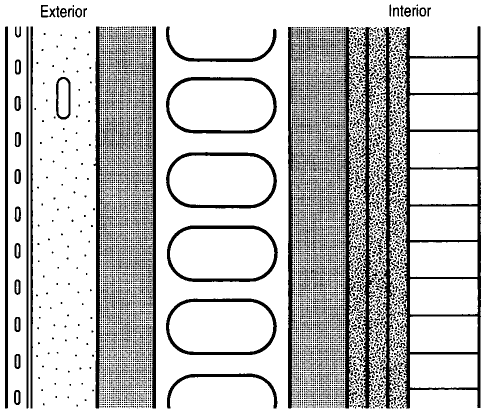 Figure
1. Starship hull layers: According to the Star Trek: The Next Generation
Technical Manual, "The exterior shell is composed of interlaced microfoam
furanium filaments. These filanents are gamma-welded into a series of contiguous
composite segments that are 4.7 cm thick and are typically two meters in
width. The substrate segments are electron bonded to three reinforcing layers
of 1.2 cm biaxially stressed tritanium fabric, which provide additional
torsion strength. In areas immediately adjacent to major structural members,
four layers of 2.3 cm fabric are used. The substrate layer is attached to
the major structural members by electron-bonded duranium fasteners at 2.5
cm intervals. . . . Thermal insulation and secondary SIF [structural integrity
field] conductivity are provided by two 3.76 cm layers of low-density expanded
ceramic-polymer composites. These layers are separated by an 8.7 cm multiaxis
tritanium truss framework, which provides additional thermal insulation
and a pass-through for fixed utility conduits. Radiation attenuation is
provided by a 4.2 cm layer of monocrystal beryllium silicate infused with
semiferrous polycarbonate whiskers. . . . The outermost hull layer is composed
of a 1.6 cm sheet of AGP ablative ceramic fabric chemically bonded onto
a substrate of 0.15 cm tritanium foil. . . . Also incorporated into the
outermost hull layer is a series of superconducting molybdenum-jacketed
waveguide conduits which serve to distribute and disperse the energy of
the tactical deflector system.1 Figure
1. Starship hull layers: According to the Star Trek: The Next Generation
Technical Manual, "The exterior shell is composed of interlaced microfoam
furanium filaments. These filanents are gamma-welded into a series of contiguous
composite segments that are 4.7 cm thick and are typically two meters in
width. The substrate segments are electron bonded to three reinforcing layers
of 1.2 cm biaxially stressed tritanium fabric, which provide additional
torsion strength. In areas immediately adjacent to major structural members,
four layers of 2.3 cm fabric are used. The substrate layer is attached to
the major structural members by electron-bonded duranium fasteners at 2.5
cm intervals. . . . Thermal insulation and secondary SIF [structural integrity
field] conductivity are provided by two 3.76 cm layers of low-density expanded
ceramic-polymer composites. These layers are separated by an 8.7 cm multiaxis
tritanium truss framework, which provides additional thermal insulation
and a pass-through for fixed utility conduits. Radiation attenuation is
provided by a 4.2 cm layer of monocrystal beryllium silicate infused with
semiferrous polycarbonate whiskers. . . . The outermost hull layer is composed
of a 1.6 cm sheet of AGP ablative ceramic fabric chemically bonded onto
a substrate of 0.15 cm tritanium foil. . . . Also incorporated into the
outermost hull layer is a series of superconducting molybdenum-jacketed
waveguide conduits which serve to distribute and disperse the energy of
the tactical deflector system.1 |
Probably the most promising class of materials available today are metal-matrix composites. Here, fibers or whiskers of a material such as silicon carbide are embedded in matrices of aluminum and magnesium alloys. The fibers increase the strength and high-temperature stability of the alloys. Metal-matrix composite materials are currently used in missile guidance systems and other applications.
The hardest substance known to materials science is, of course, diamond. It seems likely that someday soon diamond fibers will be synthesized and embedded in metal matrices. Perhaps Star Trek's tritanium could be created by embedding diamond fibers in a titanium-alloy matrix. Such a composite would almost certainly have exceptionally robust mechanical and thermal properties; conceivably, it might even meet the demands of 24th century spacecraft designers. (Just to be safe, the Enterprise and other starships feature a "structural integrity field" to maintain the hull's rigidity under extreme stress. An inertial damping field protects the crew against the extreme accelerations required to reach warp speeds.)
| *As measured by an observer on Earth, the relativistic effect called time dilation would lead to a different reckoning of travel time by the crew of the starship, but this introduces another set of problems that the creator of Star Trek, Gene Roddenberry, wanted to avoid. |
| +As Figures 2-4 suggest, a more detailed description of warp drive and other Star Trek technologies can be found in Sternbach and Okuda's Star Trek: The Next Generation Technical Manual, published by Pocket Books. |
In the Star Trek universe, starships, in effect, create their own wormholes.In order to provide a consistent logic and nomenclature for the operation ofthe warp drive (the malfunction and subsequent repair of which has figured prominently in many Star Trek episodes!), Sternbach and Okuda have developed the following scenario. A high-energy plasma, created by a matter-antimatter reaction, is pumped through a series of warp coils cast from a material called "verterium cortenide." Electromagnetic interactions between waves of super-hot plasma and the verterium cortenide coils change the geometry of space surrounding the engine nacelles. In the process, a multilayered wave of warped space is born, and the starship cruises off to its next destination at hundreds of times the speed of light relative to normal space. Within the warp field, however, the starship does not exceed the local speed of light and, therefore, does not violate the principal tenet of special relativity.+ Some of the starship components used in the process are depicted in Figures 2-4.
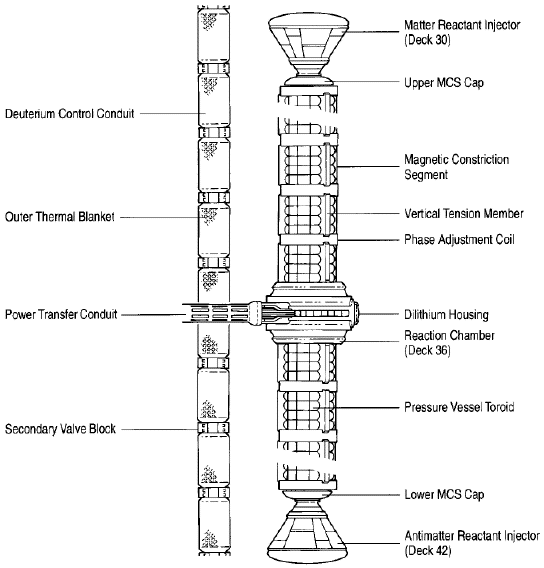 Figure 2.The matter/antimatter reaction assembly. The reaction
chamber is constructed of 12 layers of hafnium 6 excellon-infused carbonitrium,
which have been phase-transition welded at 31 MPa. The three outer layers are
armored coated with acrossenite arkenide.
2 Figure 2.The matter/antimatter reaction assembly. The reaction
chamber is constructed of 12 layers of hafnium 6 excellon-infused carbonitrium,
which have been phase-transition welded at 31 MPa. The three outer layers are
armored coated with acrossenite arkenide.
2 |
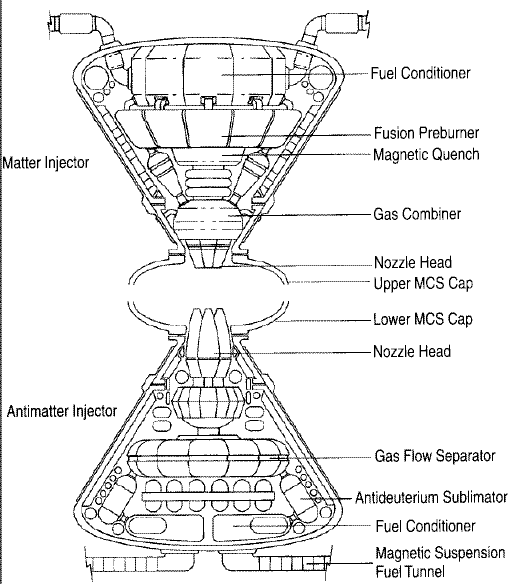 Figure 3. A detail of the matter/antimatter injectors shown in
Figure 2.3 Figure 3. A detail of the matter/antimatter injectors shown in
Figure 2.3 |
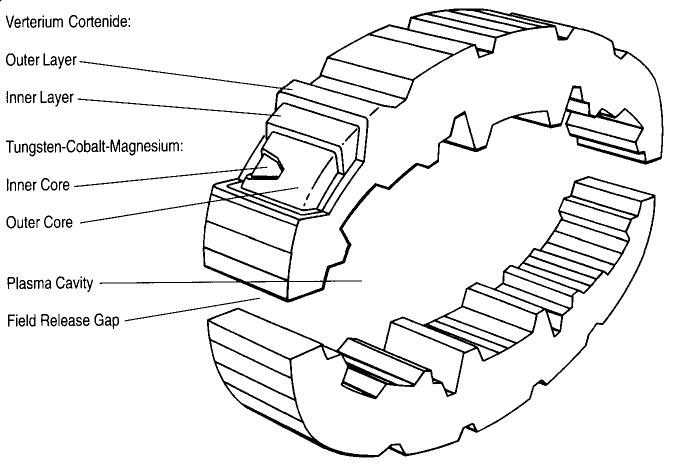 Figure 4. A typical warp field coil segment.
The densified W-Co-Mg core is embedded with a casting of electrically densified
verterium cortenide. A complete pair measures 21 m x 43 m and weight nearly
35 kt. A starship such as the Enterprise is outfitted with two complete
sets of 19 coils each.4 Figure 4. A typical warp field coil segment.
The densified W-Co-Mg core is embedded with a casting of electrically densified
verterium cortenide. A complete pair measures 21 m x 43 m and weight nearly
35 kt. A starship such as the Enterprise is outfitted with two complete
sets of 19 coils each.4 |
If this happens—that is, if it is someday shown that gravity is simply one manifestation of a single general force—it may then be possible to manipulate gravitational forces through the application of electromagnetic forces, which we know how to generate and control precisely. This could give us the capability to control the geometry of space with electromagnetic forces. In the Star Trek universe, we assume that the unification of the forces of nature has been achieved, and the verterium cortenide warp coils are the medium through which electromagnetic forces are used to alter the geometry of space.
About the Author
André Bormanis
is science consultant to the television series Star
Trek: Voyager and Star Trek: Deep Space Nine.
Direct questions about this or any other JOM page to jom@tms.org.
| Search | TMS Document Center | Subscriptions | Other Hypertext Articles | JOM | TMS OnLine |
|---|